

APEX Framework for AI Implementation
What is the APEX Framework
APEX is strongly aligned with official AI governance frameworks such as ISO/IEC 42001, NIST AI RMF, and regulatory mandates like the EU AI Act, making it a preferred enterprise option for robust, compliant, and scalable AI management.
The APEX framework is designed to complement and be in line with Official & International Standards
Overview: Why Frameworks Matter
Many AI initiatives stall when they outpace an organization’s readiness—such as executive sponsorship, master data management, or cross-functional governance. Frameworks provide shared terminology, tooling checklists, and audit pathways, enabling firms to scale AI responsibly and comply with evolving regulations like the EU AI Act.
AI tools only deliver durable value when they rests on mature leadership, robust data foundations, integrated systems, and disciplined governance.
Official and industry frameworks have emerged to guide organizations through these prerequisites, ranging from certifiable international standards to vendor-neutral maturity models.
Introduction
The APEX structure is defined by three interconnected components:
- The Macro-Level Cycle
- The Prioritization Engine
- The Implementation Blueprint: 10 Actionable Steps
It is a targeted prioritization engine designed to cut through decision paralysis and vendor noise to identify the highest-impact AI opportunity.
I. The Macro-Level Cycle:
APEX (Assess, Prioritize, Execute, Expand)
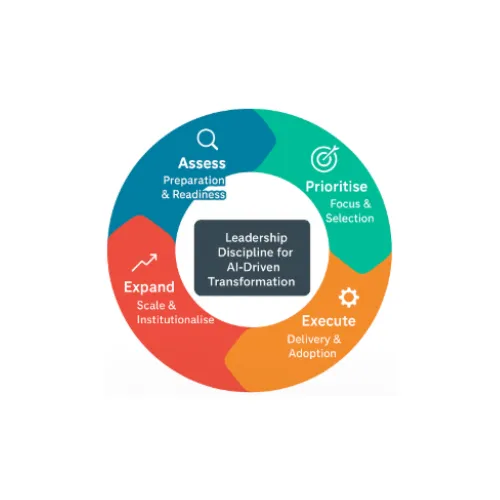
The APEX acronym represents a four-phase, sensible, repeatable, and sustainable cycle that serves as a leadership discipline for AI implementation.
II. The Prioritization Engine:
Five-Dimensional Scoring and Tiered Elimination
III. The Implementation Blueprint: 10 Actionable Steps
The APEX framework organizes the AI journey into 10 actionable steps across key categories, designed to ensure alignment and build the necessary foundation for AI success.
Successful AI requires focusing on people and process as well as platforms and algorithms.
Assess, Prioritize, Execute, Expand
I. The Macro-Level Cycle:
APEX (Assess, Prioritize, Execute, Expand)
The APEX acronym represents a four-phase, sensible, repeatable, and sustainable cycle that serves as a leadership discipline for AI implementation.
- Assess: Taking an honest look at data, teams, infrastructure, strategy, and governance before investing in technology.
- Prioritize: Focusing on high-reward, low-friction projects to gain early, visible wins, using the five-dimensional strategic scoring (needs, impact, feasibility, cost, alignment) to select the single highest-impact opportunity.
- Execute: Running small, lean, tightly scoped pilots ruthlessly focused on solving a real business problem at scale.
- Expand: Scaling successful pilots into true enterprise-wide capabilities, baking the new tools into core operations.
Scoring and Tiered Elimination
II. The Prioritization Engine:
Five-Dimensional Scoring and Tiered Elimination
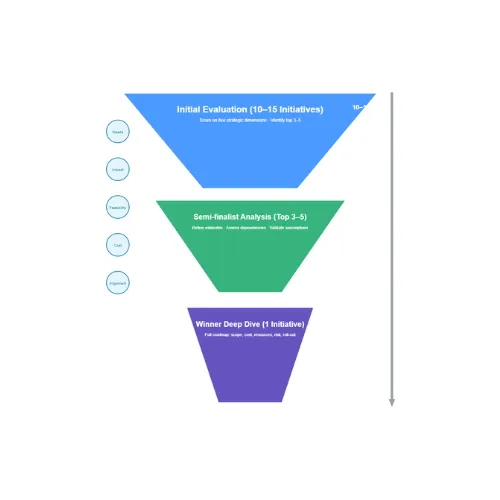
APEX uses a system of competitive elimination to transparently narrow down possibilities to a single winning initiative.
- Most Pressing Needs: Addressing the squeakiest wheels, biggest pain points, and highest priorities for key stakeholders.
- Biggest Impact: Determining which issues, if resolved, would drive revenue or increase margins the most.
- Technical Feasibility: Assessing what current AI/ML technology can reasonably accomplish, favouring “slam dunks” and steering clear of marginal outcomes.
- Cost and Complexity: Calculating the resources, money, and time required to actually deploy the solution.
- Strategic Alignment: Ensuring the initiative moves the organization toward total organizational intelligence rather than creating another silo.
10 Actionable Steps
III. The Implementation Blueprint:
10 Actionable Steps
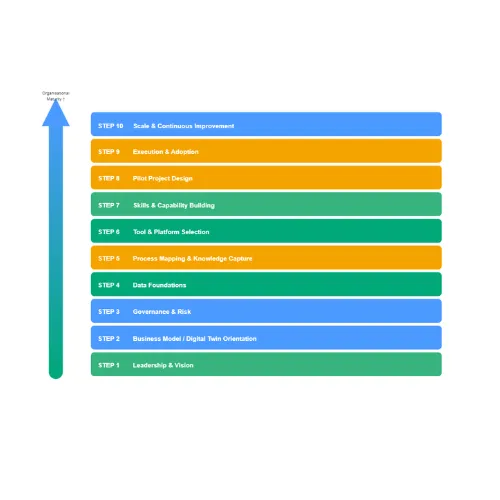
The APEX framework organizes the AI journey into 10 actionable steps across key categories, designed to ensure alignment and build the necessary foundation for AI success.
- Leadership & Vision
- Business Model / DTO
- Business Glossary
- Master Data Structure
- Integrated Business Systems
- Cognitive Intelligence Centre
- Data Governance Structures
- Ethical AI Governance
- Capability Building
- Continuous Optimization