

What is the Cognitive Intelligence Centre?

From scattered AI experiments to a single, governed system of intelligence for your organisation, designed for leaders who want AI to change how the business thinks, not just how it types.
The Cognitive Intelligence Centre (CIC) is the organisational nervous system for your AI strategy. It is the governed environment that hosts your Digital Business Brain and every serious AI capability you intend to run at scale. Instead of scattering intelligence across tools, teams and dashboards, the CIC gives you one place where the business model, the data and the decisions come together as a single system of intelligence.
Why the CIC exists

Rich in systems of record, poor in systems of intelligence?
Critical know‑how trapped in people’s heads?
AI tools amplifying noise instead of insight?
- “Rich in systems of record, poor in systems of intelligence?”
- “Critical know‑how trapped in people’s heads?”
- “AI tools amplifying noise instead of insight?”
Most organisations are rich in systems of record and poor in systems of intelligence. Today, data is everywhere. Joined‑up reasoning about how the business actually works and what we should do next is nowhere. As a result, you get pilot purgatory and overlapping dashboards. Leaders make calls on the basis of partial information, opinion, or whatever report happens to be nearest.
At the same time, critical know‑how still lives in people’s heads. When they leave, the logic of how value really flows leaves with them. The jams in the work and the shortcuts that actually matter go too. In this context, AI tools dropped into this environment do not fix the problem. They amplify the noise.
Instead, the CIC exists to change that. It creates one governed centre where intelligence is built, tested and reused across the whole enterprise.
How the CIC works
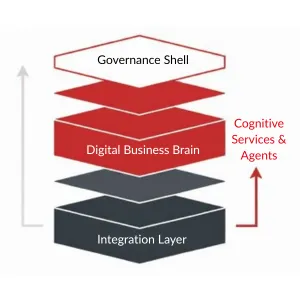
At the heart of the CIC is a simple idea: give the organisation a shared brain and clear guardrails, then let AI work inside that, not around it. The CIC brings four elements together in one operating environment.
1 Governance shell
The CIC is a governed space, not a playground. It embeds your rules on ethics, risk, quality, and security into how data, models and agents operate. You get clarity on who owns what, how decisions are made, and how AI is audited, rather than discovering those gaps after something goes wrong.
2 Digital Business Brain
The Digital Business Brain is the occupant of the CIC. It is the live model of how your business actually runs, not how the org chart says it should. It captures processes, constraints, dependencies, and institutional memory so that knowledge becomes an enterprise asset, not a personal advantage.
3 Cognitive services and agents
On top of that brain sit the tools: retrieval, reasoning, co-pilots, agents and simulations that can see the same context and work from the same facts. Instead of each AI tool rebuilding its own mini‑version of the business, everything plugs into the same nervous system.
4 Integration layer
The CIC does not replace your systems of record; it orchestrates them. It connects data sources, signals and events into a coherent picture the brain can understand and reason over. That gives you feedback loops: decisions change behaviour, behaviour changes data, and the CIC learns.
What the CIC delivers
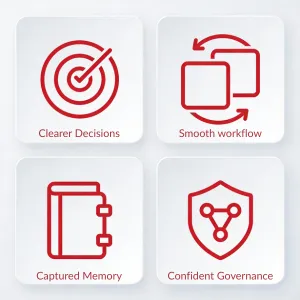
When the CIC is working, you see four shifts in how the organisation thinks and acts.
“Clearer decisions for leaders” – one truth layer, visible trade‑offs.
Leaders get one version of the business they can interrogate, simulate and challenge, rather than a parade of unconnected slide decks. Trade‑offs are explicit, options are grounded in reality, and the provenance of every key number is visible.
“Smoother flow of work” – bottlenecks surfaced, changes tested before impact.
The CIC exposes where value really gets stuck – the queues, hand‑offs and workarounds that never show up in the tidy process map. You can test changes in the Digital Business Brain before you inflict them on customers and staff, and then let agents automate what is safe to automate.
“Captured institutional memory” – expert logic becomes an asset, not a risk.
Expert know‑how is captured into the brain as patterns, playbooks and decision logic, not just documents on a shared drive. New people start from the current state of organisational intelligence, not from a blank page and a set of heroic colleagues.
“Confident governance” – explainable AI, traceable decisions.
Because all of this happens inside a governed centre, you can show how AI‑supported decisions were made, on what basis, and under which policies. That makes regulators, boards and customers easier to face – and lets you move faster without relying on blind trust.
How to establish a Cognitive Intelligence Centre
You do not “install” a CIC. You build it deliberately around the decisions that matter most. In practice, that means moving in a small number of clear steps.

1 Start with decisions, not tools
Identify the few decisions where better intelligence would materially change outcomes; ignore everything else for now.
2 Map the data and knowledge
Next, for those decisions, work out what the organisation needs to know. List the data, signals, rules, exceptions and tacit shortcuts, and where that knowledge currently lives. This becomes the raw material for your Digital Business Brain and gives you a clear inventory of what the organisation must ‘know’ for those decisions to be trustworthy.
3 Stand up the CIC shell and the brain
Then, establish the governance shell (ownership, policies, quality thresholds). Next, design and implement the first cut of the Digital Business Brain inside it, only deep enough to support the first set of decisions well.
4 Layer on cognitive services and scale by pattern
Finally, once the brain is in place, you add agents, co-pilots and analytics that use it rather than bypass it. As you prove value, you extend the brain into adjacent processes and decisions using repeatable patterns. You do not create custom projects every time.
The CIC is where your AI strategy stops being a collection of clever experiments and starts becoming organisational cognition. In practice, it gives your business a memory and a mind, and ensures each new AI capability strengthens that core instead of adding to the noise.
What next with your CIC?
Start with the decisions that matter most and the knowledge you are most afraid of losing.

