


Most leaders are now experimenting with AI tools. Someone in the team is using a chatbot. Another is trying code assistance. A third is playing with slide generators.
On the surface, it looks like progress. Underneath, a harder question remains unanswered:
Are we actually turning any of this into better decisions, better use of information, and a better way of running the business?
This page is your starting point. It brings three ideas together:
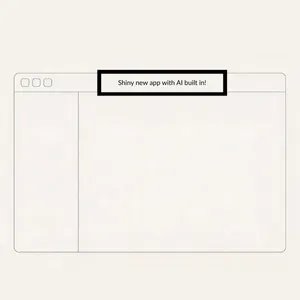
Using AI tools sensibly
Start with friction, not features.

Is your business actually ready?
Foundations decide whether AI helps or harms.
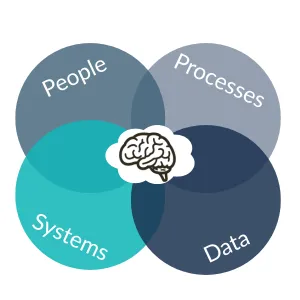
Towards a Digital Business Brain
From scattered tools to a thinking organisation

AI tools are useful: Without discipline, they encourage people to experiment faster than the business can think.
AI at the personal level is disarmingly simple.
- You type a question, it answers. You drop in a document, it summarises. You ask it to tidy an email, it does.
- This is genuinely useful. It helps individual leaders move faster and think out loud. It also creates a dangerous illusion: that what works for one person will automatically work for the business.
Personal AI vs Business AI
- Personal AI lives in your own workflow. Low risk. Informal. You are responsible for what you choose to paste in and how you use the output.
- Business AI lives in the enterprise. It touches customers, money, risk, regulation, and reputation. It sits inside shared systems, not just on your laptop.
Confusing these two is where many problems start
Personal AI vs Business AI
| Personal AI | Business AI |
|---|---|
| Used by individuals in their own workflow | Used across teams and systems |
| Low risk, informal, reversible | Higher risk, governed and auditable |
| Great for drafting and learning | Critical for decisions and operations |
The article “Using AI tools to deliver business value” goes deeper into this distinction and is worth reading alongside this page.
Start with friction, not features
The sensible way to approach AI tools is to start with friction, not features.
Questions to ask before you buy any tool
- Where does work repeatedly slow down because people cannot find or trust the information they need?
- Where do smart people spend too much time on low‑value admin and copy‑paste?
- Where do customers feel the impact of your internal confusion?
Until you can answer those questions in plain language, any conversation about tools is premature. You are optimising guesses.
Design guardrails for experiments
The point is to make personal experiments safe and informative.
What sensible AI experiments look like
- Clear rules about what data can and cannot go into public tools.
- Clear expectations about where AI can draft and where humans must decide.
- A habit of capturing what works, so experiments inform a wider strategy instead of becoming isolated tricks.
If you get the basics right at this level, you avoid most of the regrettable headlines.

Buying AI is easy; being ready for it is the hard part.
Readiness is a leadership issue
Owning AI tools is not the same as being ready for AI.
Readiness is about whether your foundations can support AI without creating chaos. It is not a technical setting. It is a leadership choice.
If you ask ten senior people what AI is for and you get ten different answers, you are not ready. If you are running pilots without a clear definition of success, you are not ready. If nobody is accountable for outcomes, only for “activity”, you are not ready.
Before you talk about models or platforms, you need agreement on three basics:
- What problem are we trying to solve?
- What does success look like in practice?
- Who is responsible for the result?
Without that, AI becomes theatre.
Five lenses of readiness
The simplest way to look at readiness is through five lenses: Data, Strategy, Infrastructure, People, Governance.
AI Readiness Checklist
Data
Strategy
Infrastructure
People
Governance
If several of these boxes are hard to tick, adding more AI will not help. It will magnify the weakness.
Before your next AI project, find out if you are actually ready.
Most organisations are already “doing something with AI”. Very few have taken the time to examine whether their foundations can genuinely support it.
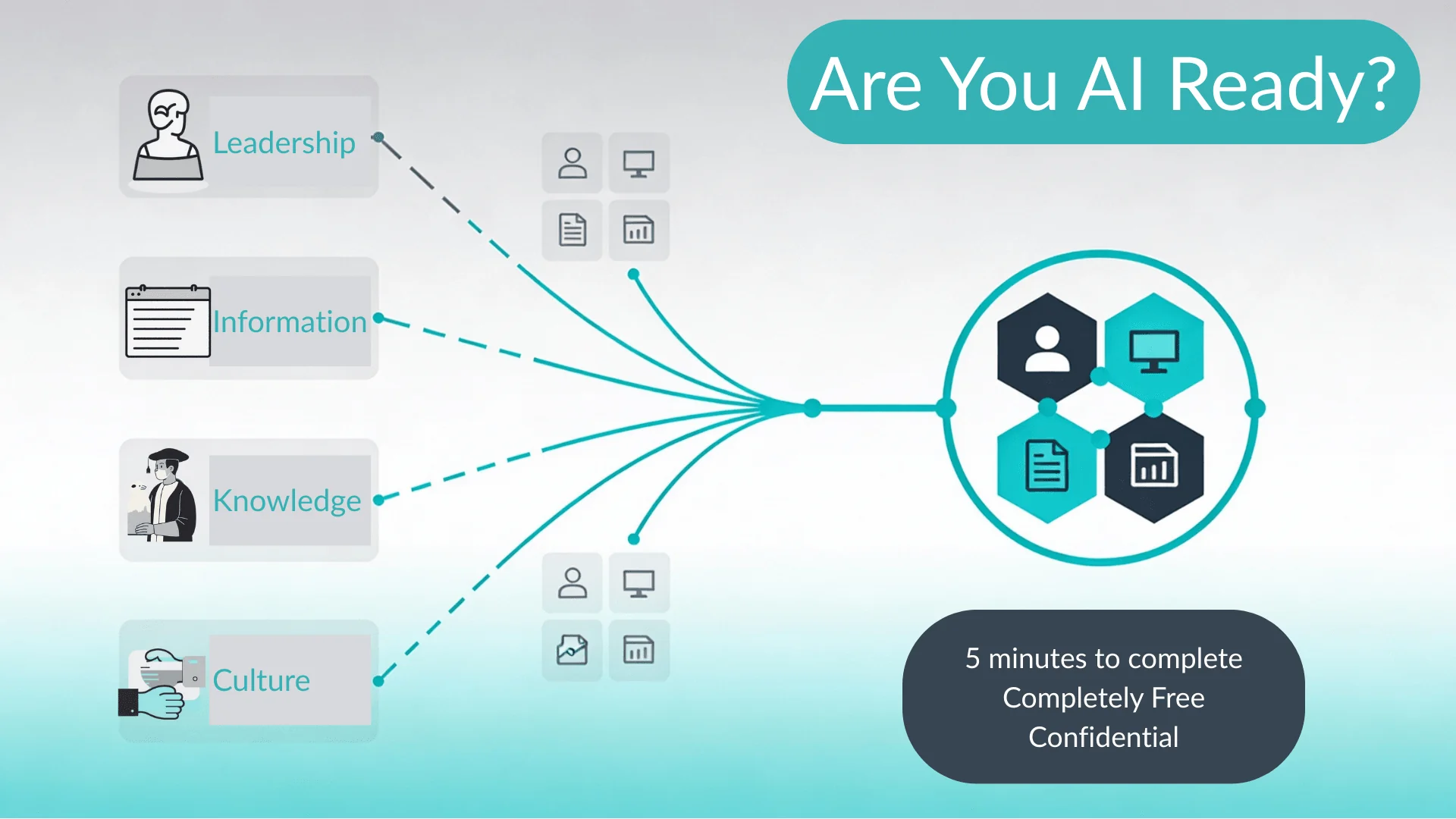
This short diagnostic is for leadership teams. It helps you see, quickly and honestly, where you are strong, where you are exposed, and where to focus first.

If you stop at tools, you get noise; if you build a brain, you get better decisions.
Many tools, scattered data
- Dashboards everywhere
- Duplication
- Slow decisions
Stronger foundations
- Shared definitions
- Cleaner data
- Clear accountability
Cognitive Intelligence Centre
(Digital Business Brain)
- Single source of meaning
- Faster answers
- Better decisions
If Basics 1 is about experiments and Basics 2 is about foundations, Basics 3 is about direction.
What are you actually trying to build over the next few years? A collection of tools, or a business that thinks more clearly?
The problem with scattered tools
Most organisations are already surrounded by systems. CRMs, ERPs, BI tools, project platforms, chat tools, document stores. Every new AI product promises to “integrate” with them.
The result is often more noise, not more intelligence:
- Multiple versions of the truth across different dashboards.
- Teams reinventing the wheel because they cannot see what others are doing.
- Leaders spending more time reconciling reports than making decisions.
This is not a technology failure. It is an architecture failure.
What a Cognitive Intelligence Centre does
A Cognitive Intelligence Centre, your Digital Business Brain, is a different way of thinking about all of this.
Instead of treating each tool as a separate island, you treat the business as a whole organism that needs a working memory and a clear view of itself.
In practical terms, a Cognitive Intelligence Centre:
- Collects and organises your key business knowledge – processes, definitions, decisions – in one place.
- Helps people get trusted answers to real questions, quickly, without hunting through ten systems.
- Shows how work actually flows across teams, so you can spot bottlenecks and risks early.
- Provides a place where AI can safely augment people: summarising, flagging patterns, and suggesting options, while humans stay in charge.
AI sits inside this centre as a support, not as the brain itself.
A practical sequence
You do not build a Digital Business Brain in one leap. Nor should you try.
A sensible sequence looks like this:
- Experiment safely – allow personal and small‑team AI use with clear guardrails.
- Understand readiness – use a structured test to see where your foundations stand.
- Choose a first slice – pick one area of the business where better information and better decisions would clearly pay off.
- Build a thin, real version of the “brain” there – map the process, centralise its knowledge, and use AI to remove friction.
- Learn, then expand – once it works in one place, replicate the pattern elsewhere.
The goal is not a giant programme. The goal is a series of visible wins that gradually add up to a business that thinks more clearly and moves with less friction.
The page “Cognitive Intelligence Centre – Digital Business Brain” goes into more depth on this concept and how it changes the rhythm of the organisation.

This page is only a starting point, but it gives you a simple frame:
- AI tools are useful, but only when anchored in real business friction.
- AI readiness determines whether those tools can be used without creating mess.
- A Cognitive Intelligence Centre / Digital Business Brain is where these efforts ultimately need to converge if you want lasting advantage, not just interesting pilots.
You do not have to solve everything at once. You do have to choose a direction.

2 Look ahead to the Digital Business Brain
Read the Cognitive Intelligence Centre / Digital Business Brain page and ask:
A Final Question to ask yourself
QUESTION: If our business worked like this, where would we feel the difference first?
Use your answer to choose your first serious AI initiative.
From there, everything else becomes easier. You move from chasing tools to building a thinking business.

